
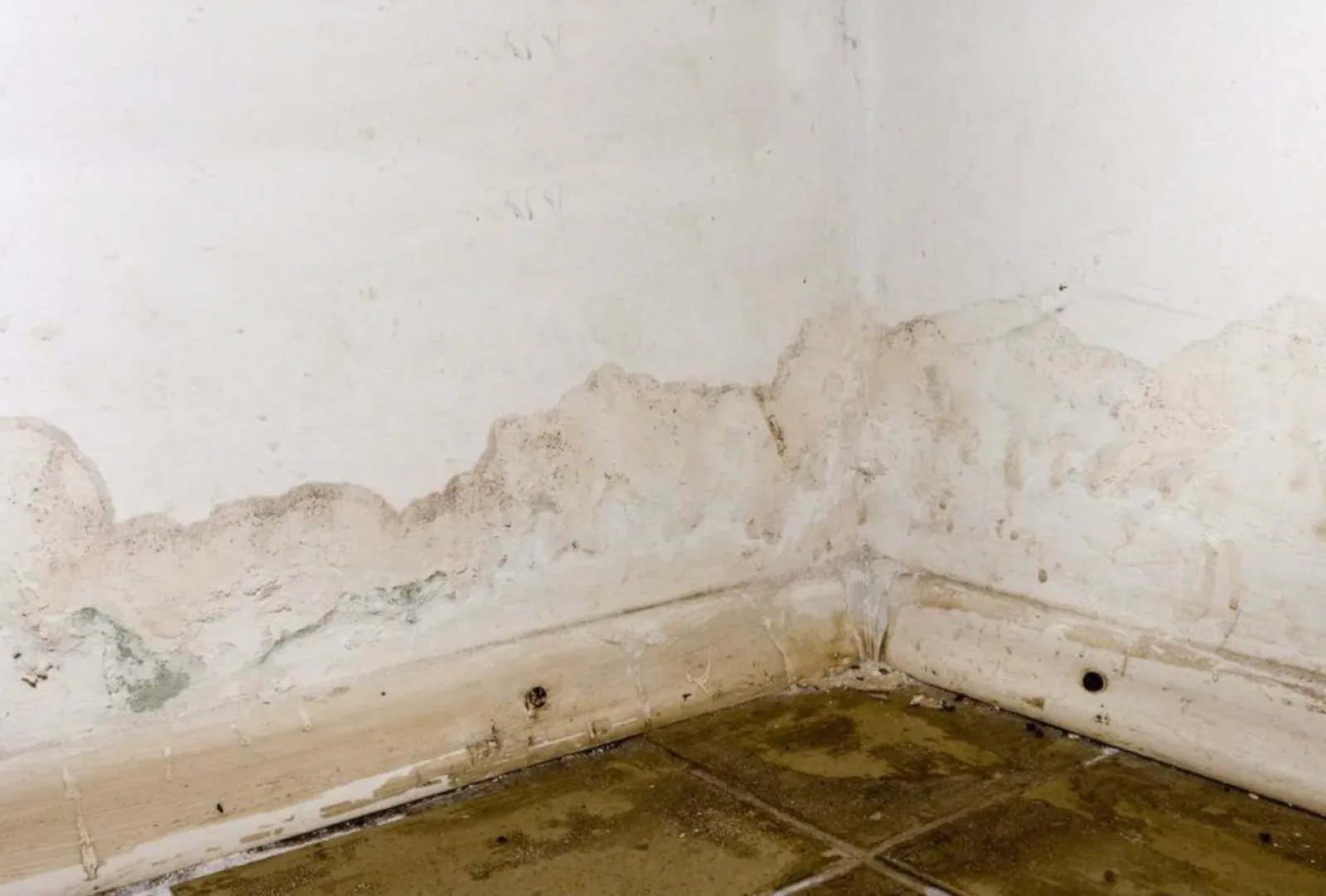
Signs you need this
- • A brown or yellow ring spreading across a ceiling or wall, often bigger by the next morning
- • A ceiling that sags, bulges, or feels soft and spongy when pressed, meaning water is pooling behind the board
- • Paint or joint tape that bubbles, blisters, or peels away from the surface
- • A damp, musty smell in a room even after the visible leak has stopped
- • Nail heads or seams showing dark streaks where moisture has wicked through the drywall
What water damage really does to drywall
Drywall is a gypsum core wrapped in paper, and both parts fail when they stay wet. The gypsum softens and crumbles, the paper facing feeds mold, and the joint tape lets go at the seams. A ceiling takes the worst of it because water collects on the top of the board and pushes down until it sags or drops. This is why Cambridge Elite Drywall & Plaster treats a soaked ceiling as urgent: the strength is already gone by the time you see the bulge, and the safe move is to open it up rather than wait and hope it dries on its own.
Cambridge sees this constantly. The city packs old, dense housing into a small footprint, much of it near the Charles where basements stay damp and top floors sit under ice-dam-prone roofs. Century-old plumbing behind the walls in Cambridgeport and East Cambridge lets go in cold snaps, and a supply line that bursts on an upper floor can run down through two levels of ceilings before anyone notices. Each of those situations soaks drywall in a different way, and the repair starts with figuring out where the water went, not just where the stain shows.
Finding the real edge of the damage
The visible stain is almost never the full extent of the problem. Water wicks sideways through the gypsum and travels along the top of a ceiling toward the low point, so the wet board can reach well past the brown ring. The crew uses a moisture meter to map the true edge before cutting, then removes board back to dry framing. Guessing here is what leaves a hidden pocket of wet gypsum inside a finished wall, and that pocket is exactly where mold starts weeks later.
Insulation matters just as much. Wet fiberglass batts hold water against the framing and lose their R-value, so any soaked insulation comes out with the board. Leaving it in traps moisture in the cavity and slows the drying that has to happen before anything gets closed up.
Drying before rebuilding
The step that separates a lasting repair from a callback is drying. Once the wet material is out, the crew reads the framing and, when the numbers are high, sets drying equipment and leaves the cavity open until the wood comes back to a normal moisture level. Only then does new board go up. Sealing a wall while the studs are still wet is the most common reason a repair fails, because the trapped moisture keeps feeding mold behind a brand-new finish.
For rooms that are likely to get wet again, such as spaces near plumbing or below grade, the crew can hang moisture-resistant board like purple M2Tech drywall instead of standard gypsum. It costs a little more but stands up better if moisture returns.
Matching the finish so the repair disappears
A water repair is not done when the board is up. Most Cambridge ceilings and walls carry a texture, whether a smooth painted finish, an orange-peel, or a knockdown, and a flat new patch stands out until it is matched. The crew tapes and muds the seams with joint compound, feathers the edges into the surrounding surface, and rebuilds the texture to blend. Water stains also bleed straight through ordinary paint, so every repair gets a stain-blocking primer before it is handed off paint-ready. That primer is why a properly restored ceiling stays clean instead of showing the old ring again a month later.
Insurance and lead-safe work
Many of these jobs run through a homeowner or landlord insurance claim. Cambridge Elite Drywall & Plaster photographs and measures the damage before removing anything, which gives you and your adjuster the documentation a claim needs. On the city’s large pre-1978 housing stock, disturbed paint can contain lead, so the company works as an EPA RRP Lead-Safe Certified Firm and follows MA 780 CMR and RRP containment on older homes. That keeps a straightforward water repair from creating a second, avoidable problem.
Materials & standards
Products & materials we use
- USG Sheetrock
- National Gypsum Gold Bond
- CertainTeed
- Purple mold-resistant board (M2Tech)
- Georgia-Pacific ToughRock
- FibaTape
Standards & codes we work to
- MA 780 CMR (Massachusetts State Building Code)
- ASTM C1396
- GA-214 finish Levels 0-5
- EPA RRP lead-safe work practices for pre-1978 housing
- Massachusetts Construction Supervisor License (CSL)
- Massachusetts Home Improvement Contractor (HIC) registration
- EPA RRP Lead-Safe Certified Firm
What the terms mean
- Moisture meter
- Moisture-resistant board
- Joint compound
- Mud and tape
- Knockdown texture
- Orange-peel
- Level 5 finish
- Stain-blocking primer
- Vapor barrier
- Cavity drying
Options & variants
| Option | When it applies | Cost |
|---|---|---|
| Stain seal and skim repair | Water stained but structurally sound board, small footprint | Lowest cost, fastest turnaround |
| Partial cut-out and patch | Localized soaking on one ceiling or wall section | Moderate, driven by how much board is removed |
| Full ceiling or wall replacement | Sagging, saturated, or collapsed board across a large area | Higher, includes new insulation if affected |
| Replacement with moisture-resistant board | Bathrooms, laundry areas, or spots likely to see moisture again | Slightly higher material cost |
What affects cost
- • How much board is wet and whether it is on a ceiling, which is harder to access, or a wall
- • Whether insulation, framing, or a vapor barrier behind the drywall also needs to come out and dry
- • The finish level and texture of the existing surface, since a smooth Level 5 wall or a knockdown ceiling takes more work to match
- • Ceiling height and access, including tall stairwells and rooms where scaffolding is needed
- • Whether the damaged area holds pre-1978 paint that calls for EPA RRP lead-safe containment
What to expect
- 1
Call and describe the damage
You call and describe where the water came from and whether it has stopped. Cambridge Elite Drywall & Plaster schedules a fast on-site visit for active damage.
- 2
Meter and document
The crew checks the affected board with a moisture meter, marks how far the water traveled, and photographs everything for your records or your insurer.
- 3
Cut out and dry
Wet drywall and ruined insulation are cut out and hauled off. The cavity is left open to dry, with drying equipment if the framing reads high on the meter.
- 4
Rebuild once dry
Once the framing is confirmed dry, the crew hangs new board, tapes and muds the seams, and matches the existing texture.
- 5
Prime paint-ready
The surface is sanded, primed with a stain-blocking primer, and left ready for paint, so the repair disappears into the wall or ceiling.
When this isn’t the right call
- If the wall you want repaired is original lath-and-plaster with hairline cracking and no water involved, that is plaster repair or a plaster-to-drywall conversion, not a water damage job.
- If the drywall is already growing visible mold across the surface and the concern is health rather than a fresh leak, that calls for mold drywall replacement.
- If the water is still actively running, a plumber or roofer needs to stop the source first, and drywall repair starts once the leak is fixed.
Frequently asked questions
Do I have to replace the whole ceiling, or can you patch just the wet part? +
It depends on how far the water spread. If a small section is soaked and the rest reads dry on the meter, a clean cut-out and patch is enough. A ceiling that sags or is wet across most of its span is safer to replace fully.
Can you work with my insurance company? +
Yes. Cambridge Elite Drywall & Plaster documents the damage with photos and measurements before removing anything, which is what most insurers ask for on a water claim.
How do you know the wall is dry before you close it up? +
The crew uses a moisture meter on the framing and cavity. New board only goes up once those readings come back down to normal, because sealing in wet framing is what leads to mold later.
My ceiling stain came back after I painted over it. Why? +
Water stains bleed through regular paint. They need a stain-blocking primer, and if the leak was never fixed the stain will keep returning until the source and the wet board are dealt with.
How fast can you come out for a burst pipe? +
Active water damage is treated as an emergency. Call and describe the situation and the company prioritizes a same-day or next-day visit to get the wet board out before it spreads.
Will the repaired area match the rest of my ceiling? +
Yes. The crew matches the existing texture, whether that is a smooth finish, an orange-peel, or a knockdown, then primes so the patch reads as one continuous surface.